

Training for a half marathon tends to surface all kinds of aches, tightness, and occasional sharp surprises that were not there when you were running a comfortable three miles on a Tuesday evening. Most of these are not serious. But not all of them should be dismissed, either. The runners who seem to make it to the start line in good shape are rarely the ones who ignored every warning sign. They are usually the ones who caught things early, understood what was going on, and adjusted before a manageable niggle became a genuine setback.
This article covers the most common running injuries that appear during half marathon training, explains why they tend to happen, and offers some guidance on when to keep going and when to get a proper assessment.
What are the most common running injuries when training for a half marathon?
The most common running injuries during half marathon training include runner's knee (patellofemoral pain), shin splints, Achilles tendinopathy, calf strain, and IT band syndrome. Most arise from doing too much, too soon. In many cases, the injury itself is less significant than the training error that led to it.
Runner's knee, which describes pain around or behind the kneecap, is arguably the most frequently reported complaint among runners ramping up their mileage. Knee pain running tends to be most noticeable on descents, after long periods of sitting, or when climbing stairs. It rarely appears out of nowhere. Usually, it builds gradually over two or three weeks of increasing load.
Shin splints is a broad term that covers pain along the inner edge of the tibia. It can range from general post-run tenderness to something that becomes uncomfortable mid-run. Runners who return to training after a break, or who increase their weekly mileage quickly, are particularly susceptible. If shin pain becomes very localised and does not settle with rest, it is worth getting assessed to rule out stress reaction in the bone.
Achilles pain running is another common presentation. The Achilles tendon attaches the calf muscle to the heel, and it takes a considerable load with every running stride. Morning stiffness, pain during the first few minutes of a run, and tenderness when you press along the tendon are all signs worth taking seriously. Achilles issues respond well to the right loading programme, but they also have a habit of dragging on if managed poorly.
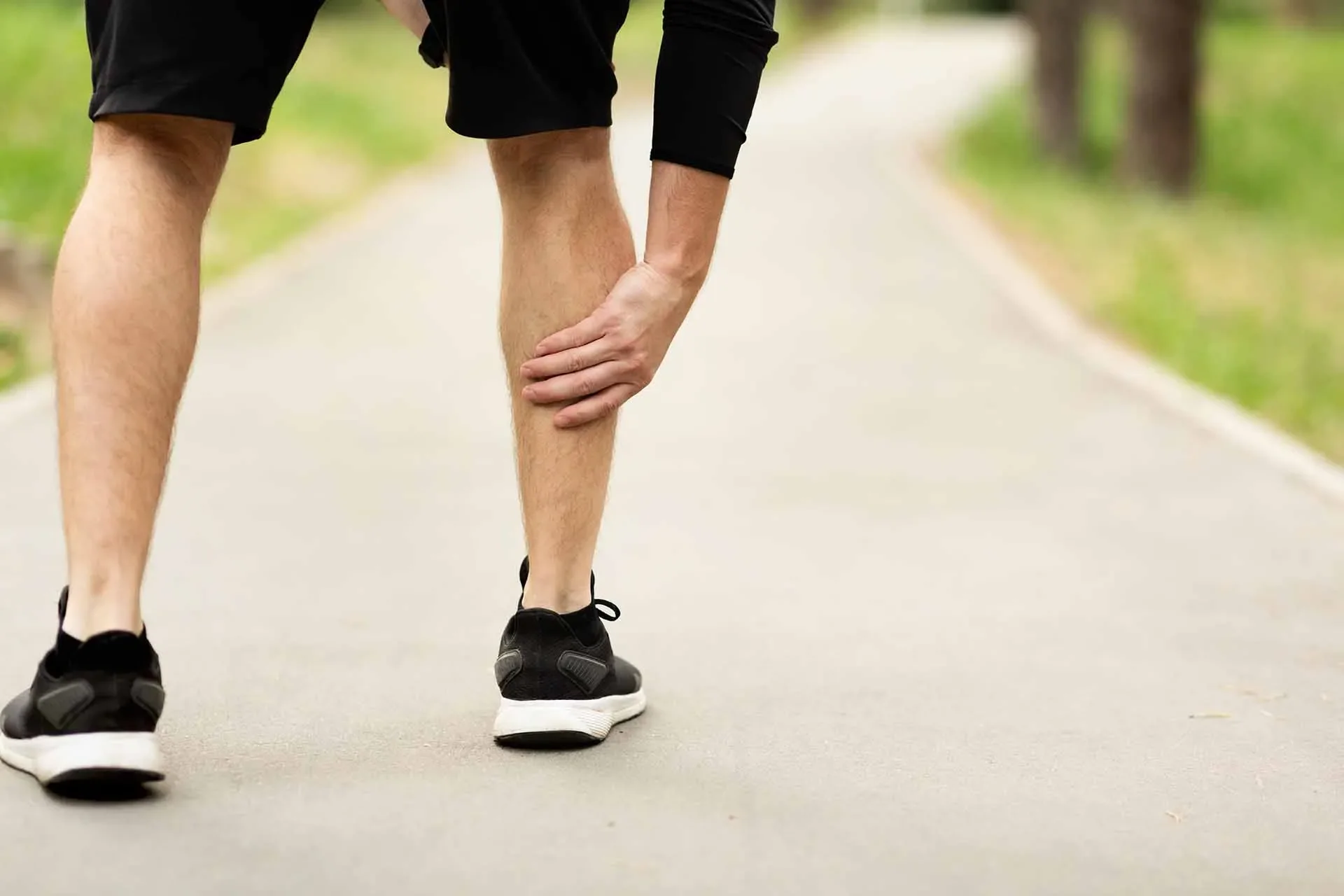
Calf strain running ranges from mild tightness that builds over weeks to a sharp, sudden pull that stops a run immediately. IT band irritation, causing pain on the outer knee, is also common in runners whose long run duration is increasing rapidly.
Why do running injuries happen during half marathon training?
Training errors cause the majority of running injuries. That is not meant to sound critical. It simply reflects what the research consistently suggests, and what most experienced runners eventually learn from experience. Tissues adapt to load over time, but they need time to do so.
The most common mistake is increasing mileage too quickly. The general guideline of not adding more than ten per cent to weekly volume is a rough heuristic, not a guarantee, but it exists for a reason. Someone who jumps from 20 miles per week to 30 miles over three weeks will often find their body catches up with them, usually in the form of calf tightness, shin soreness, or knee pain by week four.
Adding speed work or hill reps before a base of easy mileage is established is another frequent trigger. Speed sessions increase the muscular and tendon load considerably compared to easy running. Introducing them too early in a training block, before connective tissue has had time to strengthen, can overload structures like the Achilles or the patellofemoral joint.
Recovery is often underestimated. Running three hard days in a row without adequate sleep, nutrition, or rest between sessions does not give tissue the time it needs to repair and adapt. This is especially relevant for runners who are also managing demanding jobs or caring responsibilities.
Returning to training after an illness, time off, or a previous injury is another high-risk window. The cardiovascular system bounces back relatively quickly, so a run may feel aerobically manageable well before the tendons, bones, and muscles are genuinely ready for full load. Feeling fine on the run does not always mean the tissue is coping.
Should I run through pain when training for a half marathon?
Mild discomfort that settles during a warm-up and does not affect running form is generally not a reason to stop training. Pain that worsens as you run, causes you to alter your gait, is still present the following morning, or has been present for more than two weeks without improving deserves attention.
This is one of the most common questions runners ask, and it rarely has a clean yes or no answer. The honest answer is that it depends on the nature, location, and behaviour of the pain.
Some discomfort is normal. Muscles tire, legs feel heavy after a long run, and minor soreness the day after a hard effort is not a red flag. The issue arises when pain begins to change running mechanics. If you are landing differently, shortening your stride, or consciously avoiding putting weight through one side, that is a meaningful signal.
Sharp pain that begins suddenly mid-run, particularly in the calf or Achilles, should always prompt a stop. A sudden calf strain is the kind of injury that, if ignored and run through, can turn a two-week recovery into a six-week one.
Pain that lingers for more than 24 to 48 hours after a run, or that is present first thing in the morning several days after training, is worth monitoring closely. If it is still there after two or three running sessions, it is probably not going to resolve on its own without some form of modification to training or targeted treatment.
Applying a simple traffic light approach can help. If the pain is a one or two out of ten and settles within the first ten minutes of running, it is often reasonable to continue with care. If it is a four or above, worsening as the run progresses, or affecting the way you move, stopping and getting assessed is the sensible choice.
When should you see a physio for a running injury?
There is no hard rule, but a few patterns suggest that self-management alone is unlikely to be enough.
Pain that is interrupting training more than once a week, or preventing you from completing planned sessions.
Symptoms that recur every time you run, even at an easier pace.
Swelling around a joint, particularly the knee or ankle.
Any noticeable change in how you are running, such as favouring one leg or altering stride length.
Uncertainty about whether to keep training, reduce load, or stop completely.
That last point is worth emphasising. Running injury physio is not only for people who cannot walk. A physiotherapy assessment is often most useful precisely when you are unsure, when the injury is still early, and when there is still enough time in the training block to address the issue properly without losing significant fitness.
Waiting until pain becomes severe before seeking help tends to extend recovery time. An assessment early in the process can clarify what is happening, identify any contributing factors in training load or movement, and give you a clear plan rather than leaving you guessing whether to run or rest.
If you are based in or around Islington, Highbury, or North London, our physiotherapy for running injuries in Islington service is designed precisely for this kind of situation. An early assessment often makes a meaningful difference to how quickly runners get back on track.
How can physiotherapy help with running injuries?
A physiotherapy assessment for a running injury is more than a diagnosis. A good physio will want to understand the full context: your training history, how quickly you increased mileage, your race timeline, what you have already tried, and how the injury has been behaving across different sessions.
From there, the assessment typically involves looking at strength, mobility, and movement control. Weakness in the hip abductors, for example, is a common contributing factor to both runner's knee and IT band irritation. Restricted ankle mobility can put excessive load on the Achilles and calf. These are the kinds of factors that a common sports injuries assessment will explore systematically, rather than treating the site of pain in isolation.
Treatment may involve manual therapy, targeted soft tissue work, and a structured exercise programme aimed at building the specific tissue capacity that is being overloaded. At Complement Osteo & Physio, founded by Tommaso Luccarini, the approach integrates assessment and hands-on treatment with clear guidance on training modification. Rather than simply being told to rest, most runners benefit from understanding what they can do, what to reduce, and what to build.
For some runners, an integrated osteopathy and physiotherapy approach is particularly helpful, especially where pain has multiple contributing factors or where movement has been affected over a longer period. The NHS guidance on running and exercise reinforces how important structured progression and injury awareness are to sustainable training.
Return to running after injury
One of the most common patterns in injured runners is the cycle of rest, feeling better, returning to training at the previous volume, and then flaring up again within a week or two. It is frustrating, and it happens because tissue recovery and pain relief are not the same thing. Pain often reduces before the tissue is genuinely ready to handle full load again.
A structured return to running plan takes a different approach. Load is reintroduced progressively, usually starting with walk-run intervals, and building running duration gradually while monitoring symptoms. The pace of progression depends on the nature of the injury and how the tissue responds, rather than following a fixed timetable.
The aim of any return to running plan is not just to get you running again. It is to rebuild tissue capacity so that the same training triggers do not cause the same problem six weeks later. Addressing any underlying strength or mobility deficits during this phase makes a significant difference to long-term outcomes.
Most runners, with appropriate guidance, can maintain a reasonable level of fitness during this period. Cross-training through cycling, swimming, or pool running can allow cardiovascular conditioning to continue while the injury heals, which matters considerably when there is a race on the horizon.
You can find out more about how we support runners through recovery and back into training on our physiotherapy service page.
Ready to get assessed?
If a niggle is starting to affect your training, or if you are simply unsure whether to push through or pull back, an early assessment is usually the clearest path forward. We see runners at our Islington clinic in North London, serving the local community across Highbury and the surrounding area.
You can book your physiotherapy session online, or if you would like to talk through your situation before committing, we offer a free 15-minute consultation to help you decide on the right next step.
Frequently Asked Questions
-
The injuries that appear most frequently in runners training for a half marathon are runner's knee (patellofemoral pain), shin splints, Achilles tendinopathy, calf strain, and IT band syndrome. Most share a common root cause: too much load applied too quickly for the tissue to absorb and adapt. Identifying which injury is present, and what training factors contributed to it, is the starting point for getting it right.
-
It depends on the type and behaviour of the pain. Mild discomfort that settles early in a run and does not affect your movement is often manageable with continued training and some load modification. Pain that worsens during a run, alters the way you move, or persists for more than 48 hours afterwards is a reason to reduce or pause training and seek an assessment. Running through significant pain rarely accelerates recovery and often prolongs it.
-
A gradual, structured return is far more effective than stopping completely and then resuming at full volume once the pain has eased. Most return to running plans begin with walk-run intervals and progress running duration based on how the tissue responds, rather than a fixed weekly schedule. Addressing any strength or mobility deficits alongside the return is important for preventing recurrence. A physiotherapist can guide this process and adjust the plan as your training progresses.