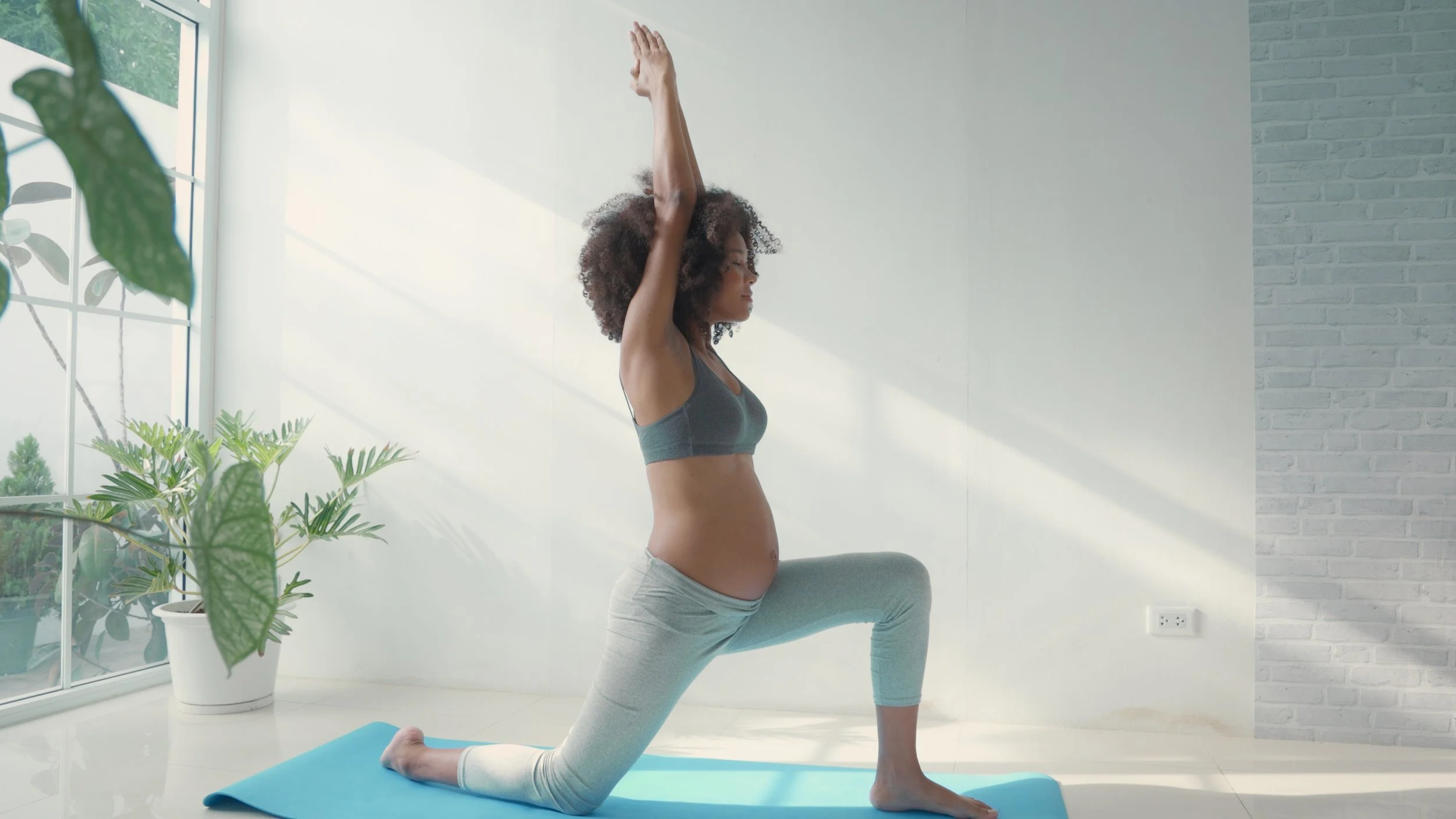
You felt strong on the reformer last month, and now the bump has started to change how everything feels. The classic positions don't look quite right anymore. The friend in your class said she was told to stop. Online opinions disagree wildly. At Complement in Islington, this is one of the most common questions we get from expectant patients: not whether to stay active, but how to keep doing the work you love safely as your body changes. This is a clinician's guide to private Pilates in Islington during pregnancy, written to clear up the safety questions trimester by trimester and to explain why a clinically-screened session is different from a generic class.
Is Pilates safe during pregnancy?
Yes, Pilates is safe during pregnancy if your pregnancy is uncomplicated and your instructor is experienced in working with pregnant clients.
This is the position taken by Tommy's, the UK's leading pregnancy charity, in its dedicated guidance on Pilates and pregnancy (tommys.org). It mirrors the broader UK Chief Medical Officers' physical activity in pregnancy guidance (gov.uk), which recommends 150 minutes of moderate-intensity activity per week plus muscle-strengthening work twice a week. Pilates fits neatly inside that recommendation: it builds strength without straining the joints, it supports posture as the bump grows, and it gives you breathing and pelvic floor work that carries straight through to labour and recovery.
There are two clear conditions. First, an uncomplicated pregnancy. If you have placenta previa, are at risk of preterm labour, are managing pre-eclampsia, or your GP or midwife has advised modified activity, you should clear Pilates with them before starting or continuing. Second, an instructor or clinician who actually understands pregnancy. Tommy's is explicit on this: check that your instructor has experience of teaching pregnant people. The reason matters. Several positions and exercises that are standard in a general Pilates class need to be removed or modified during pregnancy, and a teacher who doesn't know which ones, or why, is not the right fit for this stage.
Benefits of pregnancy Pilates: core, pelvic floor and posture
Pregnancy Pilates is one of the most effective ways to maintain deep core control, train the pelvic floor and manage the postural changes that drive most pregnancy aches.
The benefits cluster into four areas. Deep core control: as the rectus abdominis (the "six-pack" muscle) lengthens to make room for the growing baby, the deeper transverse abdominis and obliques take on more of the stabilising work. Pilates is built around training exactly these muscles in coordination with breath, which makes it well-suited to pregnancy.
Pelvic floor function: integrated breath-and-pelvic-floor work in Pilates is one of the better ways to maintain pelvic floor strength through pregnancy, which in turn supports continence, reduces the risk of prolapse and helps recovery after birth. NICE guidance on pelvic floor dysfunction (NG210) supports pelvic floor muscle training as a key preventive measure during pregnancy.
Posture and pain management: as the centre of gravity shifts forward, the lumbar spine takes a deeper curve and the upper back rounds to compensate. Both patterns drive the classic pregnancy aches we treat alongside back pain in the clinic. Pilates trains the postural muscles that resist those shifts, which often reduces day-to-day discomfort.
Birth preparation and recovery: the breath control, hip mobility and pelvic floor awareness you build through pregnancy Pilates translates directly into labour and into the early postnatal weeks. Patients who have continued Pilates through pregnancy generally find postnatal recovery faster, particularly around diastasis and pelvic floor rehabilitation.
Pregnancy Pilates trimester by trimester
Pregnancy Pilates should be modified across trimesters, with the biggest changes being the removal of supine (lying-on-your-back) work after the first trimester and the reduction of deep abdominal flexion as the bump grows.
First trimester (weeks 1 to 13). Most exercises can continue largely as before. If you were already doing Pilates, you can keep going. If you are new to it, this is a good time to start with one-to-one or small-group sessions so the instructor can build a base and learn how your body responds. Fatigue and nausea may make some sessions hard work, and that's fine: lower intensity is still useful. Avoid deep abdominal crunches and very strong rotation work even now, as the linea alba (the connective tissue down the centre of the abdomen) is already beginning to soften.
Second trimester (weeks 14 to 27). This is where the modifications become visible. UK Chief Medical Officers' guidance is clear that activities lying flat on the back are not recommended after the first trimester, because the weight of the uterus can compress the vena cava and reduce blood flow. So no supine work: bridges, the hundred lying flat, supine spine work are all removed or replaced with side-lying or incline alternatives. Reduce deep abdominal flexion (no full sit-ups, no roll-ups taken all the way down) and avoid prone (face-down) work once the bump prevents it comfortably. Side-lying, four-point kneeling and standing exercises become the workhorses.
Third trimester (weeks 28 to birth). Lower the intensity, raise the focus on hip stability, pelvic floor coordination and gentle thoracic mobility. The reformer's adjustable springs are particularly useful here, since you can use them to support movement rather than challenge it. Hip mobility work matters more in the final weeks because the relaxin-driven softening of pelvic ligaments can lead to pelvic girdle pain. Pilates work that keeps the hips moving symmetrically helps prevent this from becoming severe.
Stop or seek advice if you experience: vaginal bleeding, regular painful contractions, leaking amniotic fluid, dizziness, chest pain, calf pain or swelling, severe shortness of breath, or any sudden new pain. These are the warning signs listed in the UK CMOs' guidance, and any of them warrants stopping exercise and contacting your GP or midwife.
Mat versus reformer Pilates in pregnancy, and returning postnatally
Both mat and reformer Pilates are safe in pregnancy when modified appropriately, with the reformer often being the easier option in later trimesters thanks to its adjustable spring support.
The reformer's main advantage in pregnancy is the spring system. The same exercise can be made supportive or challenging by changing the spring tension, which means you can keep training even as fatigue, balance changes and bump size shift week by week. Many of our patients find that reformer sessions become more useful, not less, in the second and third trimesters. Mat Pilates remains entirely viable; it just relies more on your instructor's eye to modify exercises in real time.
Postnatally, the picture changes again. The general advice is to wait until your six-week GP check before returning to any structured exercise, and longer if you've had a caesarean or any birth-related complications. The first postnatal sessions focus on rebuilding the deep core (particularly diastasis recti management, the abdominal separation that affects most women in late pregnancy and which heals best with graded, breath-led loading), pelvic floor rehabilitation and gradually rebuilding strength. The same principles, the same equipment, but a very different programme.
Why clinically-led Pilates matters
Clinically-led Pilates means your sessions are screened, designed and progressed by a practitioner who can recognise pelvic girdle pain, diastasis, pelvic floor dysfunction or any complication that needs modification or referral, rather than a class instructor without that training.
This is the difference at Complement. Our Pilates is delivered alongside, and informed by, physiotherapy and osteopathy. Tommaso is a Senior Osteopath and Physiotherapist registered with the General Osteopathic Council, the Institute of Osteopathy, the HCPC and the Chartered Society of Physiotherapy. Hollie, one of our osteopaths, holds a specific pre and post-natal exercise qualification. That means an expectant patient who walks in with low back ache isn't put into a generic class and hoped for the best: she is screened first, the pain is identified as pelvic girdle pain or sciatica or simply postural, and her Pilates programme is built around that finding.
This integrated approach also means you can layer care. A patient might have weekly osteopathy in the second trimester to manage pelvic girdle pain, fortnightly Pilates to build the strength that holds the work in place, and step into a structured postnatal rehab plan once she's six weeks past birth. One assessing clinician, one ongoing pathway.
Book your private pregnancy Pilates session in Islington
If you are pregnant and want Pilates delivered by clinicians who understand the trimester-by-trimester picture, book an initial session with us. We're at Highbury Grove in N5, a short walk from Highbury & Islington station, easily reached from Canonbury, Angel, Barnsbury and King's Cross. Sessions are one-to-one and tailored to your trimester, your symptoms and your goals. We accept most major insurance providers and offer multi-session packages for patients planning regular sessions through pregnancy and postnatally.