Osteopathy and pregnancy: how integrated care supports you
The lower back ache that won't settle. The pelvic pain when you roll over in bed. The sciatic twinge that arrives in trimester two and refuses to leave. These are the symptoms most pregnant patients come to us with, and they are also the ones that respond best to gentle, well-targeted hands-on care. At Complement, our Islington clinic sits a short walk from Highbury & Islington station and offers pregnancy osteopathy at our Islington clinic to expectant patients from Angel, Canonbury and across to Camden Town. Many arrive asking the same first question: is osteopathy safe right now, and will it actually help?
Is osteopathy safe in pregnancy?
Yes, osteopathy is safe in pregnancy when delivered by a registered, suitably experienced practitioner, as confirmed by NHS guidance.
The full NHS guidance is clear on two points. First, you should mention any pregnancy-related symptoms to your GP or midwife before starting treatment. Second, you should choose an osteopath who specialises in pregnancy-related musculoskeletal complaints, rather than simply any osteopath. Tommaso, who founded our clinic, is a Senior Osteopath and Physiotherapist registered with the General Osteopathic Council (GOsC), the Institute of Osteopathy, the HCPC and the Chartered Society of Physiotherapy. He has been treating perinatal patients in north London for more than ten years. Hollie, one of our osteopaths, also holds a specific pre and post-natal exercise qualification alongside her osteopathy training, which gives expectant patients a second experienced option within the clinic.
How osteopathy and pregnancy work together: an integrated view
Osteopathy eases the most common pregnancy complaints, including lower back pain, pelvic girdle pain and sciatica, by restoring joint mobility and easing the muscles that get overworked by your changing posture.
As pregnancy progresses, the centre of gravity shifts forward, the lumbar spine takes on a deeper curve, the pelvic ligaments soften under hormonal influence, and the abdominal wall stretches. Each of these changes places new mechanical demands on joints and muscles that were not designed for them. The Royal College of Obstetricians and Gynaecologists endorses manual therapy from a physiotherapist, osteopath or chiropractor who specialises in pregnancy-related pelvic girdle pain, and confirms this treatment is safe at any stage during or after pregnancy. Pelvic girdle pain (sometimes still called SPD, symphysis pubis dysfunction) affects up to one in five pregnant women, so it is one of the most common reasons women self-refer to us.
What sets our integrated osteo and physio approach apart is that Tommaso assesses you once and brings both clinical lenses to the plan. The osteopathic side restores movement and eases pain through hands-on treatment. The physiotherapy side adds the rehabilitation: targeted strengthening for the muscles that will carry you through the rest of pregnancy and through labour. You are not handed between practitioners with overlapping notes; the same clinician carries the picture forward. If pregnancy has aggravated longstanding back pain, we factor that history in too.
When to see an osteopath during pregnancy
You can see an osteopath at any stage of pregnancy, from the first trimester through to the final weeks, and again postnatally.
In the first trimester, treatment focuses on settling pre-existing aches and preparing the body for the changes ahead. In the second, most patients begin to feel the postural shift; this is often when lower back and hip discomfort surfaces. In the third, pelvic girdle pain, rib flare and sciatica become more common, and treatment positions are adapted to keep you comfortable. After birth, osteopathy supports recovery from the physical load of labour, helps re-balance a body that has carried weight asymmetrically for months, and addresses neck and shoulder tension from feeding.
A practical note that answers a question we are asked often: yes, you should always tell your osteopath you are pregnant, even very early in the first trimester and even before you are visibly showing. Certain techniques (high-velocity manipulations of the lower back, prolonged prone positioning, direct abdominal work) are modified or avoided in pregnancy, and your osteopath needs to know.
What to expect from a pregnancy osteopathy session at our Islington clinic
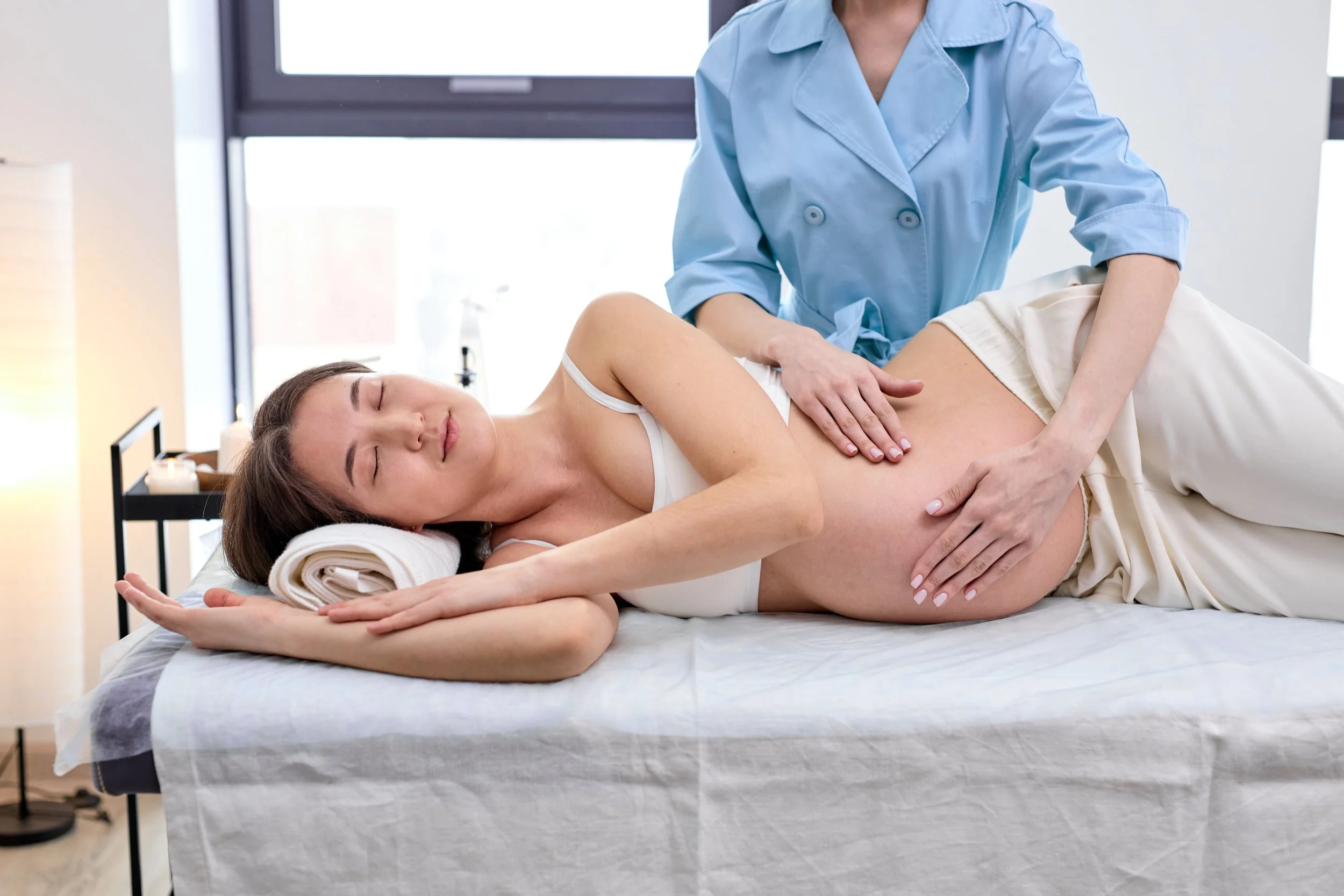
A pregnancy osteopathy session adapts the treatment position and the techniques used as your body changes, but the underlying clinical work is the same.
Your first session begins with a full case history covering your pregnancy so far, any pre-existing musculoskeletal issues, and how you are currently moving and sleeping. From the second trimester onwards, you will usually lie on your side with bolster pillows supporting your bump and upper leg, or in a semi-reclined position. Prone (face-down) treatment is avoided once the bump prevents it.
Patients sometimes ask about "forbidden pressure points" in pregnancy. The honest answer is that this language overstates the picture. There are no acupressure points so dangerous that brushing past them will cause harm. There are, however, techniques that we modify in pregnancy: certain forceful joint manipulations in the lumbar spine and pelvis, sustained deep work close to the abdomen, and very vigorous lower-leg massage in patients at higher risk of blood clots. Your osteopath knows these and adapts treatment accordingly. The hands-on work itself remains gentle, targeted, and grounded in the same clinical reasoning we apply to any other patient.
Sessions run for around 45 minutes. Most patients leave with one or two simple home exercises and clear advice on positions for sleeping, sitting and walking.
Beyond osteopathy: physio and Pilates through pregnancy and postnatal recovery
Pregnancy benefits from layered care: osteopathy for pain and mobility, physiotherapy for strength, and Pilates for breath-led core and pelvic floor work.
Pain relief and joint mobility belong to osteopathy. Strength, control and return-to-activity belong to physiotherapy and Pilates. Private Pilates for pregnancy and postnatal recovery is, in our view, the most under-used resource for expectant patients in this part of London. Pilates teaches you to recruit the deep abdominal and pelvic floor muscles that the bigger, more visible muscles tend to dominate. During pregnancy this matters for posture, pelvic floor health, and reducing the risk of pelvic girdle pain worsening. Postnatally it matters even more: the abdominal separation that is normal in late pregnancy (diastasis recti) responds to graded, breath-led loading rather than crunches or generic core work.
Our practitioners share notes, so a patient who begins with osteopathy in trimester two might add a fortnightly Pilates session in trimester three, and step into a postnatal rehab plan once they are six weeks past birth and cleared by their GP. One assessing clinician, one pathway, from bump to fully back on your feet.
Book a pregnancy osteopathy session in Islington
If pregnancy is uncomfortable, you do not need to wait it out. Book an initial assessment with Tommaso, Hollie or another member of our team, and we will plan the trimester ahead with you. The clinic is on the first floor with lift access, a short walk from Highbury & Islington station and easily reached from Barnsbury, King's Cross and Camden Town. We accept most major insurance providers and offer multi-session packages for patients who anticipate regular treatment through pregnancy and postnatally.